

Treatment on Wheels: Study Highlights Perceptions of Those Receiving Medications for Opioid Use Disorder from a Mobile Treatment Unit
Shining a light on integrated care to promote mastery and unlock human potential.
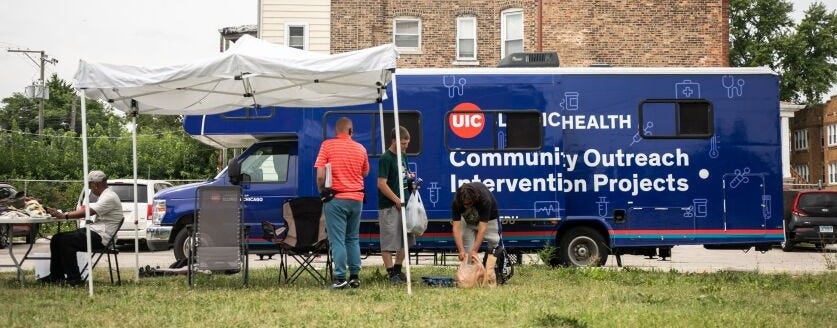
A new study shines a light on a simple but powerful idea in the fight against the opioid crisis: bring treatment directly to the people who need it the most and accomplish it with speed, dignity, and compassion.
In the United States, synthetic opioids such as fentanyl continue to drive the opioid crisis, making fatal overdoses the leading cause of death for Americans ages 18 to 44, even as total overdose numbers have declined. People with criminal-legal system involvement have much higher rates of untreated opioid use disorder. Although medications for opioid use disorder (MOUD) reduce overdose risk, only about one in five people with opioid use disorder receive it overall, with criminal-legal system-involved individuals facing added barriers, including insurance gaps during reentry, stigma from system personnel, homelessness, and housing instability. In jails and prisons, just 5 percent of those who need MOUD receive it, and only about one-third of criminal-legal referrals result in MOUD care plans. This contributes to sharply elevated overdose risks immediately after release.
Mobile units offering low-threshold buprenorphine have been implemented in several cities to improve access, providing same-day prescribing and wraparound services in high-need areas like near jails or overdose hotspots. These programs have improved treatment retention, particularly for Black individuals and those with unstable housing.
A study published earlier this year qualitatively explored experiences of participants with opioid use disorder and recent criminal-legal involvement who received services from Chicago’s Community Outreach Intervention Projects (COIP) Mobile MOUD program on the West Side—an area with persistently high overdose rates—to assess perceptions, satisfaction, and factors influencing care-seeking, with the goal of refining services for this high-risk group.
Study Objectives and Rationale
The study, which was funded by the National Institute on Drug Abuse (NIDA) and by the National Institutes of Health (NIH) through the NIH HEAL Initiative as part of the Justice Community Opioid Innovation Network (JCOIN), assessed participants’ perceptions and satisfaction with substance use treatment and wraparound services, as well as factors that influenced their decisions to seek care. These insights are essential for tailoring services to this population, which, as previously mentioned, faces disproportionately higher overdose risk compared to those without criminal-legal system involvement.
Participant Selection and Interview Process
Investigators conducted semi-structured interviews with people engaged in the mobile program who had criminal-legal system involvement in the prior 90 days. This included individuals who had been arrested, booked, or charged; released from prison, jail, or electronic monitoring; or were currently on probation, parole, or supervised release. An outreach specialist determined eligibility based on service history and medical records. Interview questions were drawn from domains of the Consolidated Framework for Implementation Research. All interviews were recorded, transcribed, deidentified, and analyzed inductively using Dedoose qualitative software. The analysis focused on perceived benefits, barriers, and facilitators to accessing mobile services among justice-involved individuals.
Demographics and Emergent Themes
Thirteen interviews were completed. Participants had a mean age of 48.5 years (standard deviation 11.4). More than half identified as Black or African American (61.5 percent) and as male (61.5 percent). In the 30 days before the interview, 53.8 percent reported stable housing, 38.5 percent were living outdoors, and 7.7 percent had been incarcerated.
Participants described the mobile unit as essential to the community due to its location near an open-air drug market and the scarcity of other local services. They consistently praised the program’s non-judgmental, approachable, and trustworthy atmosphere, which contrasted with experiences in traditional healthcare settings. Interactions with law enforcement were described as positive or neutral, and some participants reported referrals from the criminal-legal system to the mobile unit.
Facilitators to access included onsite dispensing of medications for opioid use disorder, walk-in appointments, and comprehensive medical services. Additional facilitators were word-of-mouth recommendations, shared use of services with partners, friends, or family, and personal motivation. Barriers included incarceration, transportation issues, and limited awareness of the program’s schedule and services.
Implications for Policy, Practice, and Equity
Mobile treatment units can help get treatment options into the communities that need them most. They can help disrupt the cycle of incarceration, untreated substance use disorders, and overdose deaths. By offering immediate, non-judgmental care directly in the community, they remove barriers like long wait times, lack of insurance, stigma, and transportation challenges, especially for people returning from jail or prison, when overdose risk is highest.
This study underscores the potential benefits of widespread adoption of mobile treatment programs to help get services to those with some of the highest social risk factors of health. By amplifying voices from those most affected, the findings highlight the advantages of funding peer-led recovery initiatives and integrating overdose prevention services into justice systems nationwide, potentially saving thousands of lives.
Participants in this study are asking for care that is accessible, respectful, and consistent. Mobile MOUD programs provide exactly that—and the evidence shows they save lives.
This article was based on the study, “Convenience, Quickness, and Compassion”: Experiences of People Involved in the Criminal-Legal System Accessing Medications for Opioid Use Disorder Services From a Mobile Unit in Chicago. Martinford, T., Watson, D. P., Messmer, S., Rashid, L., Staton, M., Dennis, M. L., Grella, C. E., Elmes-Patel, A., (2026). “Convenience, quickness, and compassion”: Experiences of people involved in the criminal-legal system accessing medications for opioid use disorder services from a mobile unit in Chicago. Health Expectations, 29(1). https://doi.org/10.1111/hex.70552

Free, Online Toolkit for Partnering with Communities in Substance Use Research
Chestnut Health Systems has released the final chapters of its free, online Community-Based Participatory Research (CBPR) toolkit, created to help researchers build meaningful partnerships through Community Boards of people with lived experience with substance use. This resource is informed by years of collaboration with individuals from the HEAL Connections Lived Experience Panel, the JEAP Initiative Community Boards, the CHEARR Community Boards, and the PATH Community Board.
Catalyst Poll

Chestnut Health Systems’ Lighthouse Institute is recruiting Emerging Adults (18-26 years old) facing challenges related to substance use, along with their parents, for a paid research study seeking feedback for a new recovery program called Launch. Participating families will receive Launch services at no cost, be compensated for virtual research visits, and there is no waitlist! Call or Text Alice Dawson today (541-251-8507) or fill out the form on the Launch Website for more information.

We scour all four corners of the Internet to bring you the week’s most insightful, relevant, and actionable articles, studies, and reports.
Study finds key factors linking mental health and functionality in trauma-exposed Veterans. The findings underscore the critical role depression and health functioning play in the broader context of mental health and daily life challenges among Veterans who have experienced trauma. Source: US Dept. of Veterans Affairs
Biomedical sciences professor uncovers how chronic stress and opioids rewire the brain. Study finds that prolonged stress can impair decision-making, increase vulnerability to depression and anxiety, and reduce the brain’s ability to adapt to meet life’s challenges. Source: Marquette University
Wellbeing with AI: What’s possible? Join the Department of Mental Health and experts from across the Johns Hopkins Bloomberg School of Public Health for an urgent discussion that explores the burgeoning use of artificial intelligence for mental healthcare. Source: John’s Hopkins School of Public Health
Developing a Natural Language Processing Strategy to Avoid Biased Data in Electronic Health Record Suicide Risk Modeling. EHR-reported death dates are frequently inaccurate, including EHR data from after patients’ deaths, or after suicidal actions that led to their deaths, which potentially biases suicide prediction models. Source: Psychiatry Online
Attention-Deficit/Hyperactivity Disorder Traits in Childhood and Physical Health in Midlife. These findings suggest that early ADHD traits are associated with poorer long-term physical health, highlighting the importance of early identification and targeted support across the life course. Source: JAMA Network
A qualitative study on clients’ needs and wishes for an intervention aimed at preventing revictimization. Study results indicate that experts by experience would like to acquire skills that span emotional, cognitive, and behavioral dimensions to decrease their vulnerability for revictimization. Source: Pub Med
Afternoon naps can clear up the brain and improve learning ability. Study shows that even a nap is enough to reorganize connections between nerve cells so that new information can be stored more effectively. Source: Medical Xpress
Very Different Psychiatric Diagnoses Share Common Genes. This 2026 Nature cross-disorder genomics study demonstrated that different psychiatric disorders cluster together. Source: Psychology Today
Biological insights into schizophrenia from ancestrally diverse populations. The exclusion of the world’s most genetically diverse populations narrows our understanding of disease biology and risks exacerbating health disparities. Source: Nature
Study details the downsides of testing for pregnancy too early. At-home pregnancy testing is quick, easy, and highly accurate — only if performed on the date of the woman’s expected menstrual period. Source: Vanderbilt University News
About Chestnut Health Systems’ Lighthouse Institute
Chestnut Health Systems’™ Lighthouse Institute was established in 1986. Our mission is to help practitioners improve the quality of their services through research, training, and publishing. Serving health and human service organizations through offices in Chicago and Bloomington/Normal, Illinois, and Eugene, Oregon, Lighthouse Institute staff conduct applied research, program evaluation, training, and consultation.
Lighthouse Institute publishes books, monographs, curricula, and manuals on various issues of behavioral health, education, and program management. Institute staff have backgrounds and expertise in addictions, business, education, management information systems, psychology, public health, rehabilitation, research methods, statistics, and social work. For more, visit https://www.chestnut.org/lighthouse-institute/
Wow, the part about only 5 percent of people in jails and prisons getting MOUD really stood out to me; it's almost impressively inefficient how many barriers are put up for what seems like common sense. I'm curious what steps you think are most critcal for expanding these mobile units, and this entire piece was just so well put together.